English
AI Gateway vs Direct Provider SDKs in a Production Next.js App
A practical architecture comparison for Next.js teams choosing between direct model-provider SDKs and an AI gateway for routing, failover, policy, and observability.

Tran Kim Dat
Full-stack Engineer
A direct provider SDK is often the fastest way to ship an AI feature. An AI gateway is often the fastest way to operate several AI features consistently. The architectural mistake is treating either statement as universally true.
This guide compares the two approaches for a production Next.js application, with Vercel AI SDK and AI Gateway as a concrete example. The goal is not to recommend another layer by default. It is to identify the point where central routing and policy become worth their latency, cost, and dependency.
What changes in the request path
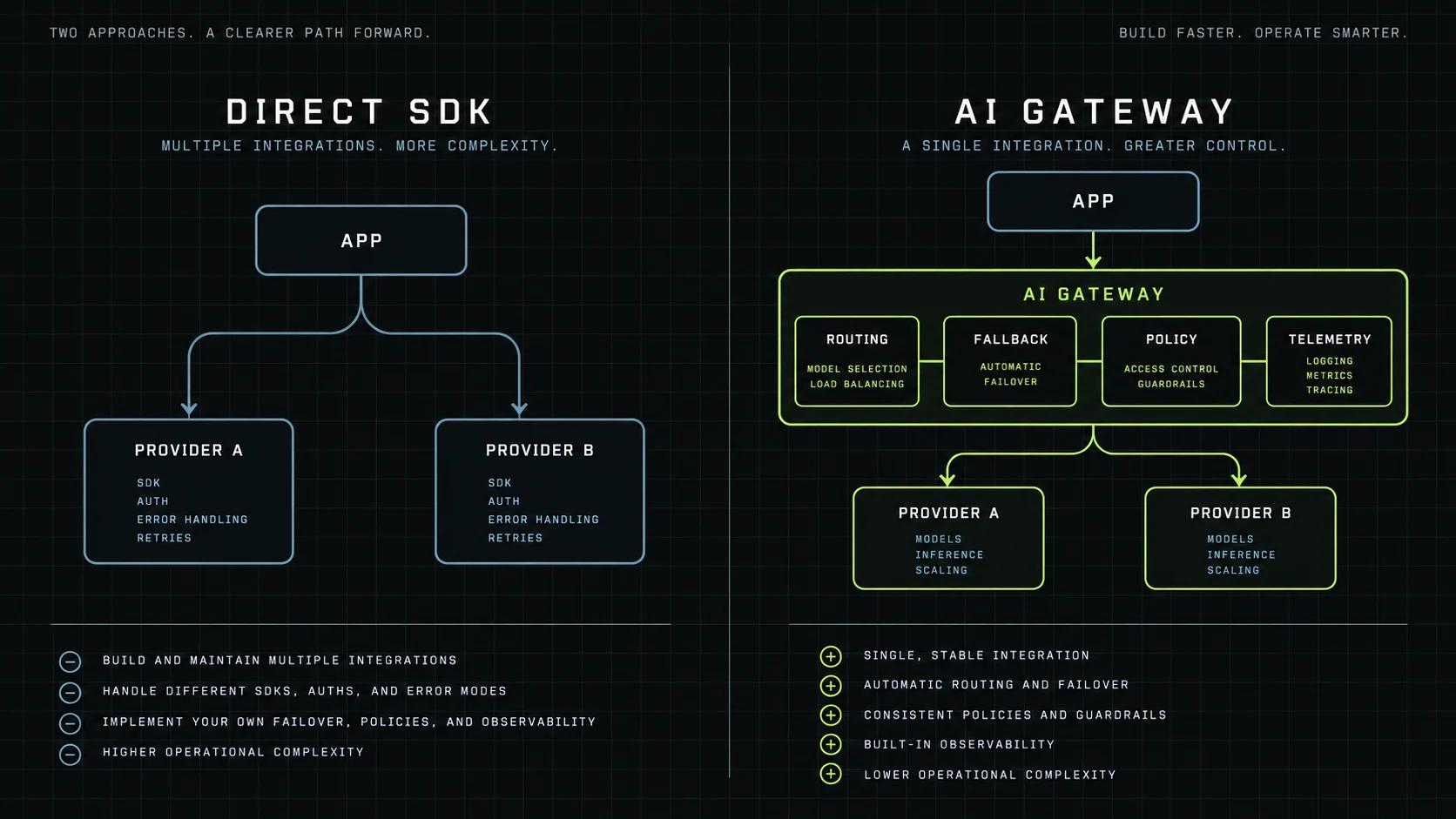
With a direct SDK, a server route or action calls the model provider. Your application owns authentication, retries, streaming differences, error normalization, usage tracking, and failover. This path is easy to reason about and exposes provider-specific capabilities quickly.
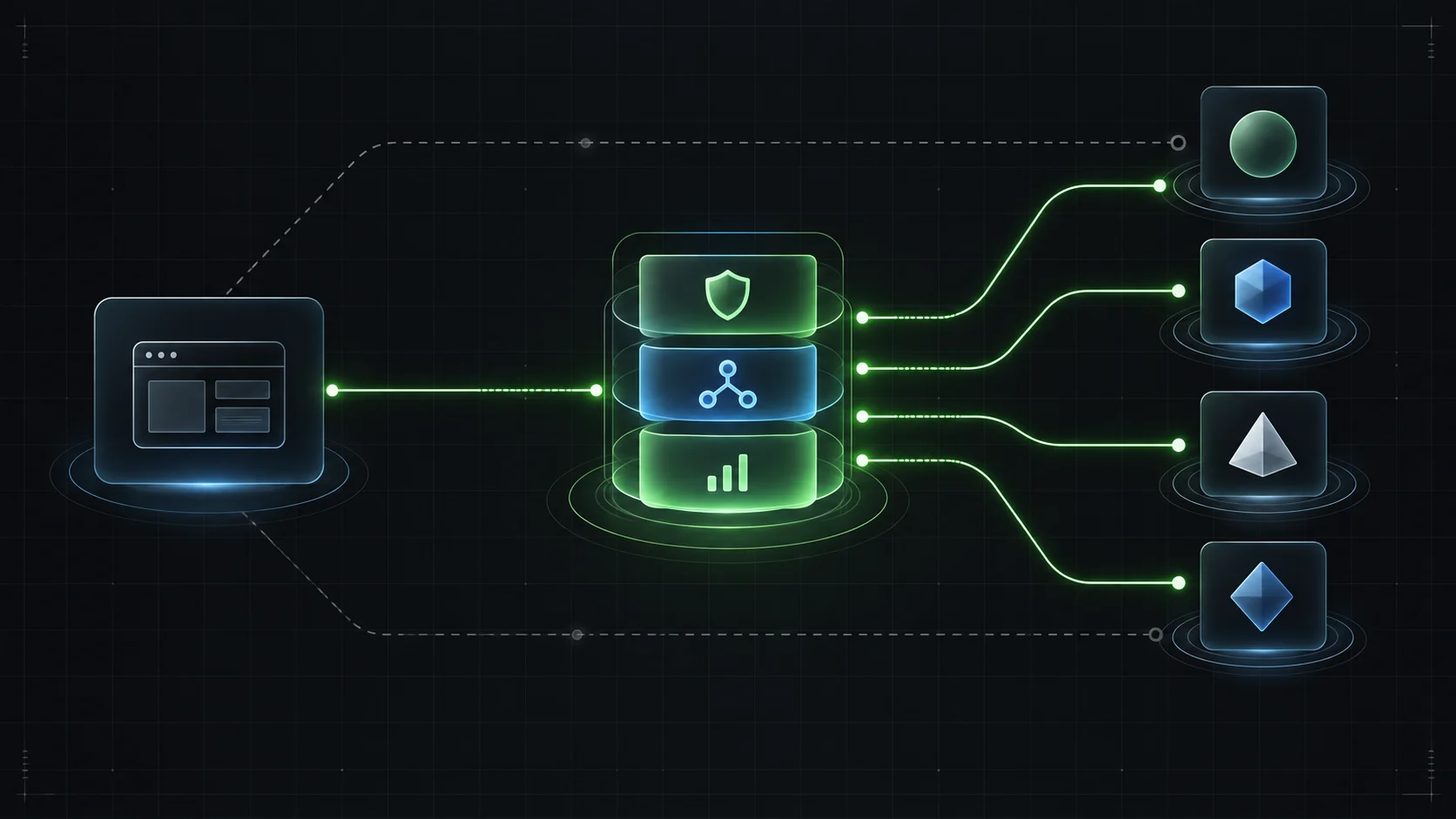
With a gateway, the application sends a common request to an intermediary that selects a provider, applies policy, records usage, and may retry or fail over. Your code becomes more portable, but the gateway becomes part of the availability and security boundary.
When a direct provider SDK wins
One provider and one model: there is little routing complexity to centralize.
Provider-specific features: you need a new capability before abstractions support it.
Lowest dependency count: fewer intermediaries simplify incident analysis.
Strict latency sensitivity: even small additional network and policy overhead matters.
Early product discovery: the team is still proving that the feature has value.
The application should still wrap the SDK behind a small domain interface. That keeps route handlers independent of vendor response types and makes later migration possible without prematurely building a platform.
When a gateway earns its place
A gateway becomes attractive when operational concerns repeat across teams or features:
Model and provider fallback for resilience.
Central usage, cost, and latency reporting.
Per-project keys and budgets.
Routing by model, geography, availability, or policy.
Consistent authentication and secret management.
A single integration surface for several model providers.
Vercel AI Gateway offers a unified endpoint across providers, usage tracking, routing, and fallbacks. Current documentation shows ordered provider preferences and fallback model lists through gateway provider options. The examples use AI SDK 7 APIs such as toUIMessageStreamResponse.
Next.js boundary design
Keep provider credentials and gateway tokens on the server. Calls belong in Route Handlers, Server Actions, or server-only modules—not Client Components. Validate user input before generation, authorize access to application data before retrieval, and return only the stream or structured result the browser needs.
For a streaming chat route, the application-layer shape should stay simple:
import { streamText } from "ai";

const result = streamText({
  model: "openai/gpt-6-astra",
  prompt,
  providerOptions: {
    gateway: {
      models: [
        "openai/gpt-5.4-nano",
        "anthropic/claude-opus-5"
      ]
    }
  }
});

return result.toUIMessageStreamResponse();
The exact model list is a product decision. Fallbacks should have compatible capabilities, safety behavior, context limits, and output contracts. “Any available model” is not a resilience strategy.
Failure semantics matter more than the happy path
Define which failures are safe to retry. A connection error before generation begins is different from a broken stream after tokens reach the user. Retrying a tool-using request can repeat side effects. Use idempotency keys for writes and keep model fallback separate from tool execution state.
Return a stable application error taxonomy: invalid request, unauthorized, policy blocked, provider unavailable, budget exceeded, output invalid, and internal failure. Preserve the upstream provider and request identifier in server-side telemetry, not in a raw browser error.
Routing policy needs quality controls
Cost-based routing can quietly lower quality. Latency-based routing can choose a model without required tools or context. Availability failover can change tone or structured-output reliability. Every routing rule needs constraints:
Required modalities and tool support.
Minimum context and output limits.
Approved data regions and providers.
Task-specific quality thresholds.
Maximum price and latency.
Evaluate the route, not just each model. A fallback policy is a small distributed system whose behavior should be tested under provider errors, timeouts, invalid outputs, and partial streams.
Observability and privacy
A gateway can centralize model, provider, token, latency, and error metrics. Your application still needs end-to-end traces connecting the user request, retrieval, generation, tools, and final result. Pass correlation identifiers through the gateway where supported.
Review content logging and retention. A gateway sees prompts and outputs unless the architecture explicitly avoids or encrypts them. Disable payload logging by default for sensitive workflows, redact personal data, and understand whether bring-your-own-key changes billing, routing, or data-handling responsibilities.
Cost is more than token price
Compare:
Provider token and tool charges.
Gateway markup or platform fees.
Engineering time for integrations and upgrades.
Incident cost when a provider is unavailable.
Observability and data-retention cost.
Quality loss from routing to an unsuitable fallback.
Vercel’s production index reports that high-scale teams use multi-model fleets and that agent workloads are token-heavy. This is aggregate platform data, not proof that every application needs a gateway. A single-model product with stable demand may remain simpler and cheaper on a direct SDK.
A low-risk migration path
Wrap the current provider call behind an application interface.
Record baseline quality, latency, errors, and cost.
Introduce the gateway for one non-critical workflow.
Keep the same primary model and disable complex routing.
Compare output parity and operational telemetry.
Add one tested fallback with explicit compatibility rules.
Move policy and budgets only after ownership is clear.
This sequence keeps rollback easy. It also reveals whether the gateway solves a real operational problem or merely relocates configuration.
The decision framework
Choose a direct SDK when the feature is narrow, provider-specific, latency-sensitive, or still being validated. Choose a gateway when multiple providers, repeated policy, centralized budgets, and failover are already creating application complexity. Maintain a provider escape hatch for critical capabilities, and test the full request path regardless of architecture.
Daily.dev is useful for tracking gateway changes such as bring-your-own-key handling and production agent patterns. For implementation, always return to the current platform and SDK documentation; gateway APIs and model identifiers change quickly.
Primary sources and further reading
Information and model identifiers checked on September 22, 2026.