English
Jev AI: Typed Decisions vs GPT-6 Astra and Claude Fable 5.1
Jev does not compete with frontier LLMs by writing better prose. It turns program state into typed, probabilistic decisions. Here is how TypeSafe AI's System One model works, where its claims need scrutiny, and when to use it beside GPT-6 Astra or Claude Fable 5.1.

Tran Kim Dat
Full-stack Engineer

Information and pricing in this article are current as of September 22, 2026. This is a source-based technical analysis, not a private benchmark. Where a number comes from a model vendor, I label it as vendor-reported and link to the methodology.
Most AI product architecture still begins with a language model: send a prompt, receive text, parse the text, validate it, and decide whether the result is safe enough to use. TypeSafe AI is challenging that sequence with Jev, its first public “System One” model. Jev does not try to write the best answer. It tries to return a small, typed decision that software can consume directly.
That makes the obvious comparison with GPT-6 Astra and Claude Fable 5.1 slightly misleading. Astra and Fable are general frontier models designed for reasoning, coding, tools, research, and rich generation. Jev deliberately gives most of that up. The useful question is not “Which model is smartest?” It is “Which layer of the system should each model own?”
What Jev is—and what it is not
TypeSafe describes Jev as a machine-native decision model. An application sends a state plus one or more narrowly defined questions. Jev returns typed answers, probability distributions, and—in the case of Choice and Score—confidence values. The public API exposes three primitives:
Choice selects one option from a predefined set and returns the selected value, a probability for every option, and confidence.
Score places the state on an ordered rubric. The result may fall between levels and includes the distribution and confidence.
Noul evaluates a statement as a probability between zero and one—a probabilistic yes or no.
The unusual name “Noul” matters less than the interface. All three question types can share one request. TypeSafe says they are evaluated independently and in parallel against the same state, so adding another narrow question should have much less latency impact than asking an autoregressive model to reason through a growing checklist sequentially.
Jev is not a chatbot, a coding agent, a research assistant, or a prose generator. It cannot draft the customer reply it has routed, produce a migration plan, browse a website, or edit a repository. It is closer to a learned function inside a program: messy state in, constrained decisions out.
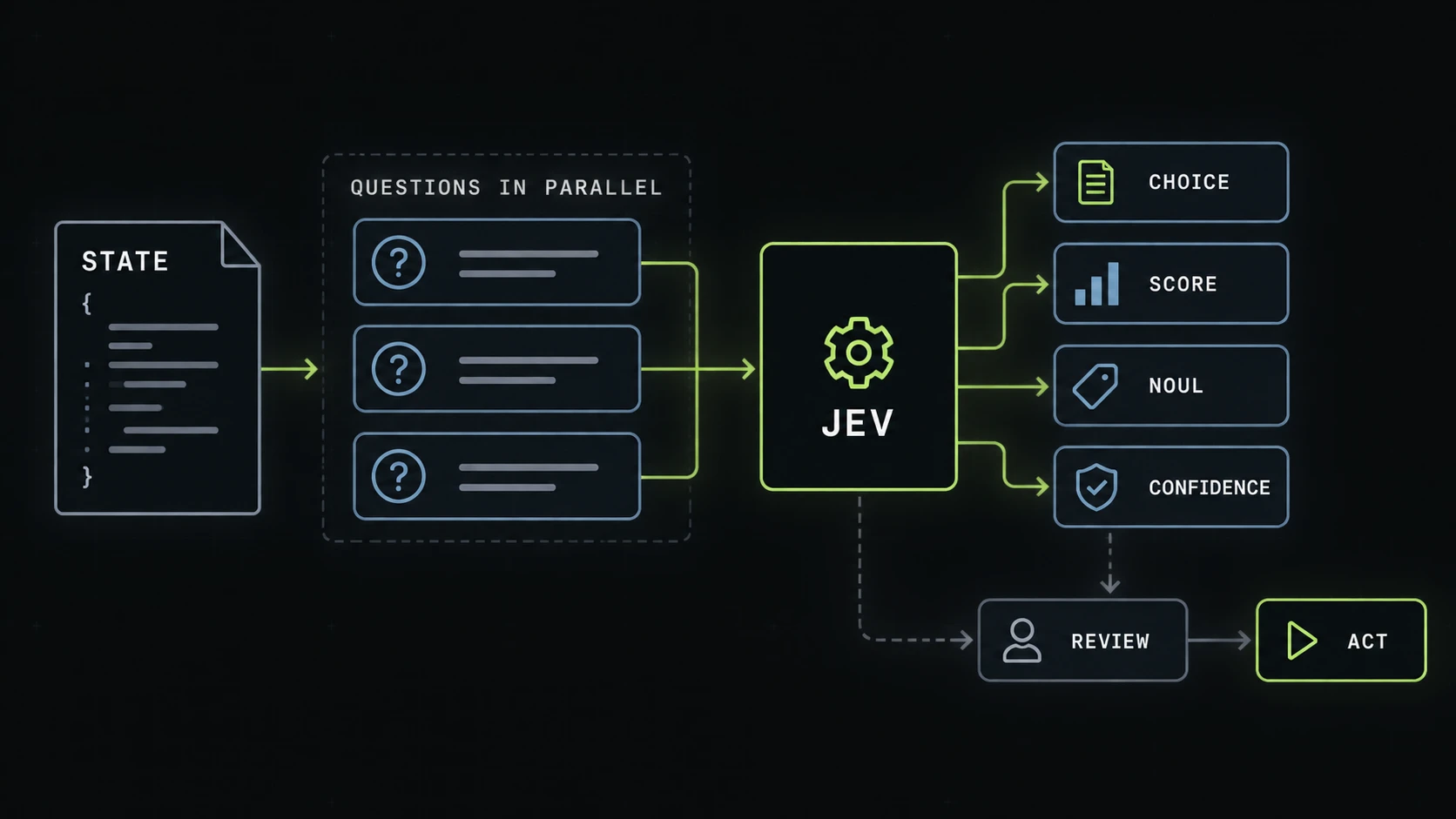
Jev evaluates narrow questions in parallel and returns typed values plus confidence, so ordinary code can choose whether to act or escalate.
Why typed decisions change the architecture
Structured output from an LLM is useful, but it is still generated by a model whose native medium is a token sequence. A production integration normally needs a schema, validation, error handling, retries, and policy checks around that output. Jev reverses the emphasis: the answer space is defined before inference, and free-form generation is removed from the product entirely.
This gives developers two different kinds of reliability to reason about:
Structural reliability: the response matches the declared answer type. TypeSafe calls this “no type errors.”
Semantic reliability: the selected choice or score is actually appropriate for the state.
The first can be guaranteed by the interface. The second cannot. A perfectly typed wrong decision is still wrong. This distinction is essential when TypeSafe uses phrases such as “zero hallucinations.” In the narrow sense, Jev cannot wander into an invented paragraph or malformed tool call because it does not generate strings. In the broader product sense, it can still misclassify, mis-score, or assign unjustified probability. Confidence-aware thresholds, private evaluation data, monitoring, and human review remain necessary.
Schema correctness is not decision correctness. Jev removes one failure class; it does not remove uncertainty.
A TypeScript example: support routing as code
The API shape makes the design concrete. The following server-side example asks three questions in one call, then uses ordinary control flow to decide whether to automate or escalate. Keep the API key on the server; do not expose it in browser code.
type ChoiceAnswer = {
  type: "choice";
  choice: "billing" | "technical" | "sales";
  confidence: number;
  probabilities: Record<string, number>;
};

type JevResponse = {
  answers: {
    department: ChoiceAnswer;
    frustration: { type: "score"; score: number; confidence: number };
    isUrgent: { type: "noul"; noul: number };
  };
};

export async function routeTicket(ticket: string) {
  const response = await fetch("https://api.typesafe.ai/v1/systemone", {
    method: "POST",
    headers: {
      Authorization: "Bearer " + process.env.TYPESAFE_API_KEY,
      "Content-Type": "application/json",
    },
    body: JSON.stringify({
      model: "jev-latest",
      state: ticket,
      questions: {
        department: {
          type: "choice",
          instructions: "Which team should handle this ticket?",
          criteria: {
            billing: "Payments, invoices, refunds, or subscriptions",
            technical: "Bugs, outages, or integration failures",
            sales: "Pricing, plans, or purchase questions",
          },
        },
        frustration: {
          type: "score",
          instructions: "How frustrated does the customer appear?",
          criteria: ["Calm", "Concerned", "Frustrated", "Very angry"],
        },
        isUrgent: {
          type: "noul",
          instructions: "The ticket is time-sensitive or blocking revenue.",
        },
      },
    }),
  });

  if (!response.ok) throw new Error("Jev request failed");
  const result = (await response.json()) as JevResponse;
  const route = result.answers.department;

  if (route.confidence < 0.65) return { action: "review", result };
  if (result.answers.isUrgent.noul > 0.8) {
    return { action: "priority-route", team: route.choice, result };
  }
  return { action: "route", team: route.choice, result };
}
The code—not the model—owns the policy. Teams can raise the review threshold, add a second approval rule, or weight a probability without rewriting a long prompt. That separation is one of Jev’s strongest ideas.
Jev’s strongest advantages
1. Low latency for repeated micro-decisions
TypeSafe reports end-to-end latency of roughly 70–500 ms for Jev. That range is attractive for routing, ranking, moderation gates, UI personalization, agent-tool approval, and other paths where several seconds would feel broken. The architectural gain compounds when one request evaluates many independent questions in parallel.
2. A radically lower price for its intended task shape
TypeSafe lists Jev at $0.042 per million input tokens, with output tokens free because the response is a small typed decision. GPT-6 Astra and Claude Fable 5.1 are both listed at $10 per million input tokens and $50 per million output tokens at standard token pricing. On input price alone, that makes Jev about 238 times cheaper.
This is not an apples-to-apples model price comparison. Astra and Fable can produce long answers, write code, use tools, and solve open-ended work that Jev cannot attempt. Jev’s advantage appears when a team is paying a general model to make thousands or millions of small, repeatable judgments.
3. Confidence is part of the contract
Many LLM applications ask the same model to output an answer and then invent a confidence score. Jev makes a probability distribution part of the response contract. That lets the surrounding software treat uncertainty as data: automate high-confidence cases, request clarification in the middle, and send ambiguous cases to a person.
4. Better composability with ordinary software
A Choice can drive a switch statement. A Score can adjust priority. A Noul result can open or close a gate. These outputs are small enough to log, test, aggregate, and monitor. The model becomes a component in a compute graph rather than the owner of the entire workflow.
Where Jev is weaker
No rich generation: Jev cannot write the final email, plan, report, query, or patch.
Task decomposition moves to the developer: good results depend on narrow questions, distinct criteria, thresholds, and code that combines the answers correctly.
A constrained answer space can hide missing options: a Choice needs an explicit “other” path when the taxonomy may be incomplete.
Confidence needs calibration against your distribution: a threshold that works for support tickets may fail on fraud, hiring, or safety data.
The evidence base is young: Jev launched in early access, and most public performance claims currently come from TypeSafe itself.
It is not a universal reasoning engine: TypeSafe’s own guidance recommends decomposing questions that require extended reasoning or multiple independent factors.
That last point defines the boundary. If the job is “choose one of these known routes,” Jev may fit. If the job is “investigate an unfamiliar system, reconcile conflicting evidence, devise a plan, and execute it across tools,” a frontier LLM is the appropriate starting point.
Jev vs GPT-6 Astra
GPT-6 Astra is OpenAI’s general frontier model for complex reasoning, coding, browser and computer use, research, and professional artifact creation. Its API supports structured outputs, function calling, web and file search, code execution, computer use, MCP, and other tools. The model documentation lists a 1,050,000-token context window and up to 128,000 output tokens.
Astra wins when the work is open-ended. It can interpret an incomplete objective, gather information, operate software, generate an explanation, and adapt across a long trajectory. It is also far better suited to coding, research, document creation, multimodal input, and agentic work.
Jev wins when the output must be a small decision at high volume. It is cheaper, faster, and easier to constrain. Its probability distribution is more useful than a paragraph when the next step is an if-statement.
Astra’s weaknesses in this comparison are mostly consequences of generality: higher token cost, longer latency, more output to validate, and a larger behavioral surface. Structured output makes Astra easier to integrate, but it does not turn a generative model into Jev’s parallel decision architecture.
Jev vs Claude Fable 5.1
Claude Fable 5.1 is Anthropic’s current generally available flagship for difficult coding and knowledge work. Anthropic positions it for long-running, asynchronous jobs that span tools and applications. Fable 5.1 keeps the original Fable 5 price of $10 per million input tokens and $50 per million output tokens, while lowering cache-read pricing to $0.25 per million tokens. Anthropic estimates that change reduces typical workload cost by about 25% and highly agentic workloads by up to about 45% compared with Fable 5.
Fable wins on sustained knowledge work. It can inspect repositories, reason across large contexts, write and revise code, use tools, and produce the human-readable artifact. Its predecessor, Fable 5, introduced the fifth-generation model line in June 2026; Fable 5.1 is the September update and the fairer current comparison.
Jev wins on bounded operational judgments. If a workflow needs to classify every event, score severity, or decide whether an agent action requires review, using Fable for every branch may be unnecessary. Fable also has safeguard and fallback behavior in sensitive cyber and biology domains, which can affect predictability for those workloads.
As with Astra, Fable’s rich generation is both the feature and the cost. Jev removes that flexibility to make one class of operation more controllable.
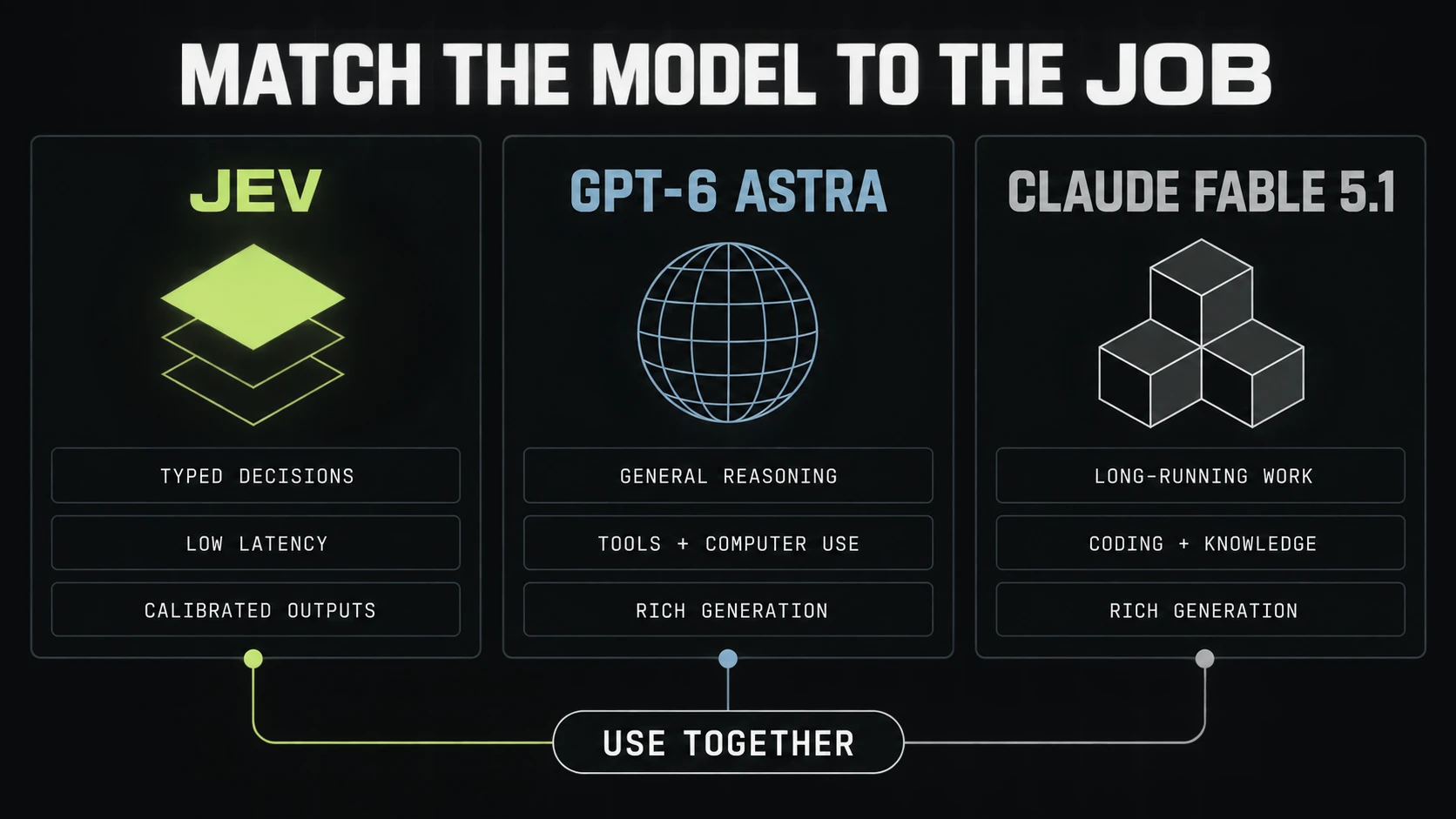
The models solve different layers of the stack: Jev is optimized for decisions; Astra and Fable 5.1 are general frontier models for reasoning, tools, coding, and generation.
How much should we trust the benchmark claims?
TypeSafe reports that Jev is up to 193.6 times faster and 444.6 times cheaper in its published workflow evaluation. The evaluation site covers four workflows: security incidents, agent-trace observability, invoice processing, and customer service. Reference labels are produced from the average responses of GPT-6 Astra and Claude Fable 5.1 at high thinking, while other models run at provider-default reasoning settings.
The company also publishes unusually useful caveats. It says the headline gains are likely at the high end of real-world results; the workflows were built by its model-capabilities team; and competing LLMs were wrapped to return Jev-compatible probabilistic decisions, which improves comparability but adds time and cost. TypeSafe separately argues that public benchmarks are easy to over-optimize and says its evaluations should be treated as dated snapshots.
My reading is cautiously positive:
The latency, price, and schema claims are concrete enough for a team with access to reproduce.
The workflow benchmark is relevant to Jev’s intended use, but it is vendor-designed and vendor-run.
Using Astra and Fable as reference labels measures agreement with frontier models, not objective truth.
The comparison does not prove that Jev is generally as intelligent as Astra or Fable; it suggests competitive decisions on selected System One-shaped tasks.
The responsible adoption path is simple: bring a private dataset, define the cost of each error type, test calibration by confidence band, and compare the full system—not only the model call.
The architecture I would actually deploy
I would not replace a frontier model with Jev. I would put Jev around one.
Use Astra or Fable for open-ended work: understand the request, research context, plan, call tools, generate code, or draft a response.
Use Jev for repeated decisions: classify the request, score risk, route to a tool, detect whether a trace needs review, or judge whether an output satisfies a narrow criterion.
Keep policy in code: define thresholds, permissions, budgets, retries, and escalation paths outside every model.
Use humans for consequential ambiguity: low confidence should change the path, not be hidden behind a forced answer.
Evaluate the composition: measure end-to-end task success, false positives, false negatives, latency, cost, and review load.
A support agent is a useful example. Jev can route and prioritize the ticket. Astra or Fable can inspect account history, reason about policy, and draft the response. Jev can then score whether the response addresses the request and whether it should be reviewed. Deterministic code decides whether the email is sent. Each component owns the type of work it handles best.
Which model should you choose?
Choose Jev when:
the answer fits a known choice, ordered score, or yes/no probability;
latency and per-call cost matter at large volume;
software—not a person—will consume the result;
you can define escalation thresholds and evaluate them on private data;
you want a decision component inside a larger workflow.
Choose GPT-6 Astra when:
the task needs broad reasoning, research, coding, computer use, or many tools;
the desired output is a document, analysis, implementation, or other rich artifact;
the work is ambiguous and the model must adapt its plan as it proceeds;
you need OpenAI’s large context and tool ecosystem.
Choose Claude Fable 5.1 when:
the task is long-running, context-heavy coding or knowledge work;
repository understanding and sustained iteration matter more than micro-latency;
your stack is already built around Claude, Claude Code, or Anthropic’s cloud integrations;
cache-heavy agentic workloads benefit from the lower Fable 5.1 cache-read price.
If your product does all three kinds of work, the answer is probably a composition rather than a winner.
Final take
Jev’s most important contribution is not a leaderboard number. It is the argument that software-facing intelligence deserves a different interface from human-facing intelligence.
GPT-6 Astra and Claude Fable 5.1 are broad engines: they reason, generate, use tools, and navigate ambiguity. Jev is a narrow instrument: it turns state into bounded decisions with probabilities. That narrowness creates real advantages in cost, latency, type safety, and operational control—and real limitations in generation, autonomy, and general reasoning.
I would not bet a production system on the phrase “zero hallucinations.” I would take the typed interface seriously, test the calibration on my own data, and use Jev where a probabilistic function is more valuable than another paragraph. The model is not a replacement for frontier LLMs. It may be the missing decision layer that makes them easier to deploy responsibly.